Friday, November 24, 2006

What Is Thehighest Psat Score

The Incredible Euro. "We want a currency so strong? OPA


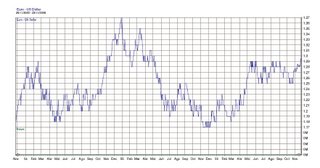
Gone are the days when our esteemed and never well weighted Euro traded below the psychological barrier of 1 USD / EUR.
The truth is that since the end of 2002 surpassed the psychological barrier, our Euro has been thrown into the bush and how! Reached the end of 2004 reaching a record high of 1.37 USD / EUR. During last year we had a period of relief, when the Euro depreciated, but this year 2006 we again placed in the orbit of 1.30 USD / EUR.
Clearly the fact that the Euro has appreciated by 9.32% so far this year has helped cushion the impact of rising oil prices and, therefore has helped contain inflationary pressures.
But what about the Euro area exports? bad business to our foreign trade (and interior) , as the appreciation of the Euro stops our exports (and imports easier.) Because of the appreciation of the Euro our goods and services abroad are more expensive (you have to deliver more USD in exchange of goods and services produced in EUR) and imported goods and services we are cheaper (you have to deliver at least EUR in exchange for goods and services produced in USD).
In other words, goods and services produced within the Euro zone have poor marketing (both domestic and export) due to loss of competitiveness caused by the appreciation of our currency. This is a torpedo at the waterline of our productive economy.
Meanwhile, the objective of price stability European Central Bank takes us in the past year have occurred five interest rate rises (presumably there will be a sixth) to stand at 3 , 25% after two and a half years of being set at 2%.
How
these increases affect us guys? First, a rise in interest rates has as its primary objective of price stability, ie keep inflation within certain levels. But as with any decision there are some side effects. Regardless of the effect, more or less immediate than on the cost of mortgages are, there is another side effect, the appreciation of the EUR against the USD.
However, in this case, the interest rate increases do not explain the appreciation of the EUR against the USD, because, although the official rate of EUR has risen 1.25% in the last year the Federal Funds Rate (the official interest rate of USD) has continued the trend that began in mid-2004 (then the official interest rate was USD 1%) and grown in the last year stood at 1.25% to 5.25%.
In fact, there is rising interest rates is explained by the appreciation of a currency, but the reduction (or expansion, as appropriate) rate differential with respect to the currency you are comparing and in this case, the past year there has been no change in the differential rate of EUR against the USD . The higher the interest rate of EUR against the USD higher the attraction to investors that currency (higher EUR demand and therefore a higher price of this coin).
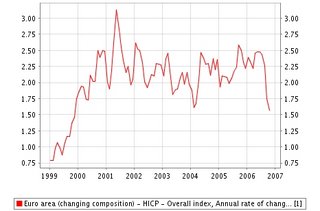
said all this, you must justify rate hikes in the euro zone, inflationary pressures do they exist to justify the increases? In principle, the escalation of oil prices presaged so, but annual rate of change of prices in the euro area in October (1.6%) is the lowest since November 1999 . The rate increase has more than fulfilled its objective, the oil starts to release pressure from speculators on demand (Ah, but they were not Chinese?), Is not the time to relax a bit and further our competitiveness?
Thursday, November 9, 2006

Theme Tunes Herb Alpert

consumer or victory

Today I had breakfast with the news that the secretary general of the Energy has announced a sharp increase in electricity tariff for next year. Has left little to the croissant I choked and spilled out the cut.

So it was that, all this mess of takeovers and anti-takeover stemmed from a rise in rates would increase operating margins and therefore your investment in the purchase of shares in Endesa . In short, the price paid for the shares of Endesa, the end is not going to pay or Gas Natural and E. On, but the ordinary people unhappy. Well, I get my stake in the company, I am a customer of Endesa!

The truth is that the ad will not catch me by surprise, he saw it coming. The worst of the matter is that this announcement gives greater scope to the president of Endesa, Mr. Pizarro to try to become entrenched in his armchair. It appears that this increase in tariffs allow Endesa to negotiate with financial institutions the advancement of quantities, in other words, could discount it as if it were a promissory note. Why? The answer is far-fetched, but at the same time simple
  1. To advance the payment of dividends to shareholders. With this, the current leadership of the company try to have happy stockholders and that they were more resistant to the tempting offers of the bidders. Somehow, that is, for shareholders, bread today, hunger for tomorrow.
  2. Endesa to squander resources and make the company less attractive to bidders, as the resources generated by Endesa for the rate increase in the future would be committed to financial institutions and the largest debt of Endesa will not result in a greater productive capacity.
  3. To thank her white knight (Acciona) services provided. Distributing these dividends "reduce" the cost of acquiring the package purchased by Acciona.

In short, a full-blown poison pill. It would be desirable

not take decisions that affect the ability to generate resources sector while we are in these processes, we see that changing the rules of the game helping or hurting the parties involved.

Tuesday, November 7, 2006

Cured From Alopecia Universalis

Relocation

delocalized in full fever, when it seems that the future of the productive economy is in Eastern Europe, China, etc ..., we are surprised at Nissan Motor Iberica intention to expand production at its plant in Barcelona starting production in 2008 of a new model. In fact, since early October have been extended shifts to meet orders from South Africa and Russia. And all this at the beginning of a more than likely the car sector crisis.

the past two years the factory has joined Barcelona 1,500 workers raises while lowering production costs. Is it avoidable the process of relocation? How can we recover the competitiveness that seems to lose because of labor costs?

The first thing to consider is that price is not equal to cost, ie wage cost is not equal to production cost . We will have to consider not only the wage costs, but also the cost of downtime and production delays, the cost of losses and errors, not the cost of quality, cost logĂ­sitica inefficient management, etc.

is, somehow we have to prove that we deserve a better wage workers from countries that focus our attention when it comes to offshoring, we need to show that we produce better, faster, more efficient production as well management.

In short, we need more professional skills, make a difference so it is justified the pay gap between these countries and Spain. We need investment in training. Just learning ability gives us a sustainable competitive advantage.

is not an easy challenge, but not impossible. Yes, attention: training begins and is most significant in children and in that sense, it is very disturbing reports we queued from Europe to education.